
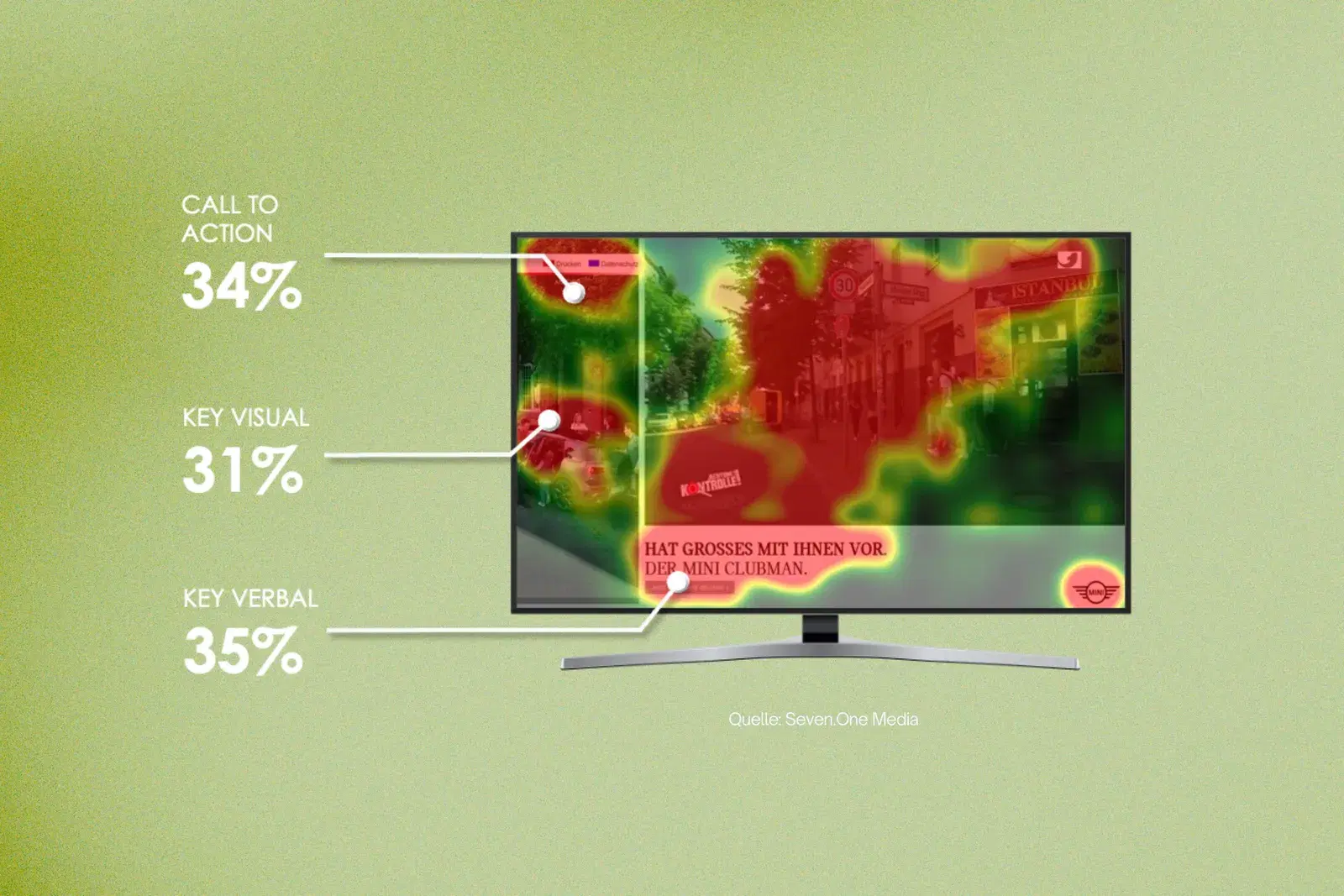
A SwitchIn appears at the moment of a channel change, as an L-banner framing the running TV picture. The obvious question: does anyone actually look at it, or is the viewer just waiting for the programme to fill the screen again? You cannot answer that with a survey, because hardly anyone consciously notices where their own gaze goes. But you can with eye-tracking. And the answer is encouraging for the format.
What eye-tracking measures on the SwitchIn
Eye-tracking, also called gaze tracking, records where the eye moves, how long it stays in one place and in what order the elements are viewed. From these fixations comes a heatmap, on which strongly noticed areas are coloured warm and overlooked ones stay cool. For the SwitchIn, this settles the decisive question: does the gaze stay on the ad, or does it slip straight back into the shrunken programme window?
Show up where eyes go!
Book a demoThe gaze stays on the ad
For a SwitchIn, the TV marketer Seven.One Media carried out an eye-tracking study together with the market research institute phaydon (2017). It measured how the gaze is distributed across the roughly ten seconds the banner is visible.
The result: attention was spread fairly evenly across the three central elements of the ad, the key verbal at around 35 percent, the call to action at around 34 percent and the key visual at around 31 percent. None of the three was overlooked, all got their share of the gaze. At the channel switch, then, the gaze goes to the SwitchIn instead of passing it by.
That fits the logic of the format. The switch moment reaches viewers in an active second, when they are looking at the screen anyway. Because the SwitchIn prominently frames the picture while letting the programme run on, it creates high visibility without acting as a disruptive interruption.
What that means for designing your SwitchIn
One clear consequence follows from this. If all three zones of your SwitchIn are seen, then every zone has to work. A strong key visual alone will not carry it if the message beside it is unclear, and the best copy fizzles out without a recognisable next step. So plan your L-banner deliberately into these three areas: an instantly recognisable brand, a message you grasp in seconds, and a call to action that says without detour what to do. How to bring brand, message and call to action into the L-banner in practice is shown in the article How to design a SwitchIn.
That is exactly what good design is for: not wasting the gaze you are given. Because a SwitchIn runs without sound, the design carries the whole message.
How to run it with onescreen
With onescreen you bring your SwitchIn onto the big screen without any video production, place it in premium environments and target it specifically by region, age, gender and interests. The switch moment ensures your banner appears exactly when attention is high. What the format involves technically is shown on the SwitchIn page.
Conclusion
The worry that a SwitchIn might simply be overlooked at the channel switch is dispelled by eye-tracking: the gaze stays on the ad and spreads across its important elements. That puts success in your hands. Design brand, message and call to action clearly, and you turn ten seconds on the big screen into a real advertising contact.
Want to bring your SwitchIn to the smart TV? Book a demo and we will show you how in 30 minutes. Or get started in the Ad Manager.
FAQ
Does anyone really look at the SwitchIn when changing channels? An eye-tracking study by Seven.One Media and phaydon clearly suggests so. The gaze stayed on the ad across the roughly ten seconds and spread across its three central elements.
How is attention distributed on the SwitchIn? In that study, fairly evenly: key verbal around 35 percent, call to action around 34 percent, key visual around 31 percent. None of the three elements was overlooked.
Why does the SwitchIn get so much attention? Because the channel switch reaches viewers in a moment of active engagement, and the L-banner frames the picture prominently without interrupting the programme. This creates visibility without being perceived as disruptive.
What does that mean for the design? That every zone counts. Because brand, message and call to action are all seen, all of them should be clear, legible and understandable at a glance.