
Two ad contacts, very different value. One runs full screen on the television, with sound, to the end. The other flashes silently in the feed for a second, half covered, before the thumb scrolls on. Both count as one impression. The feed contact is cheaper to buy, no question, but only one of the two ever had the chance to work. And that is exactly what decides what your money was worth in the end.
This is what media quality measures. Three metrics make it tangible: viewability (was the ad shown visibly), view-through or completion rate (was it watched to the end) and audibility (was it also heard). This article explains the three terms in plain language and compares how streaming TV and the social media feed perform on them. The result is clearer than many expect.
Viewability: was the ad even seen?
Viewability describes whether an ad actually appeared in the visible area of the screen. The industry standard set by the Media Rating Council is surprisingly low: a video already counts as viewable once half its area was on screen for two seconds. And even this low bar is often missed by social networks.
An analysis of over 377 million ad impressions on Facebook, Instagram and YouTube, measured by the independent provider Integral Ad Science, shows the scale: only about 11% of video impressions were validly viewable under the standard. In the mobile Facebook feed, viewability was around 47%, in the Instagram feed just under 32%, and for Reels video viewability dropped to a few percent. A large share of paid advertising is therefore never really seen.
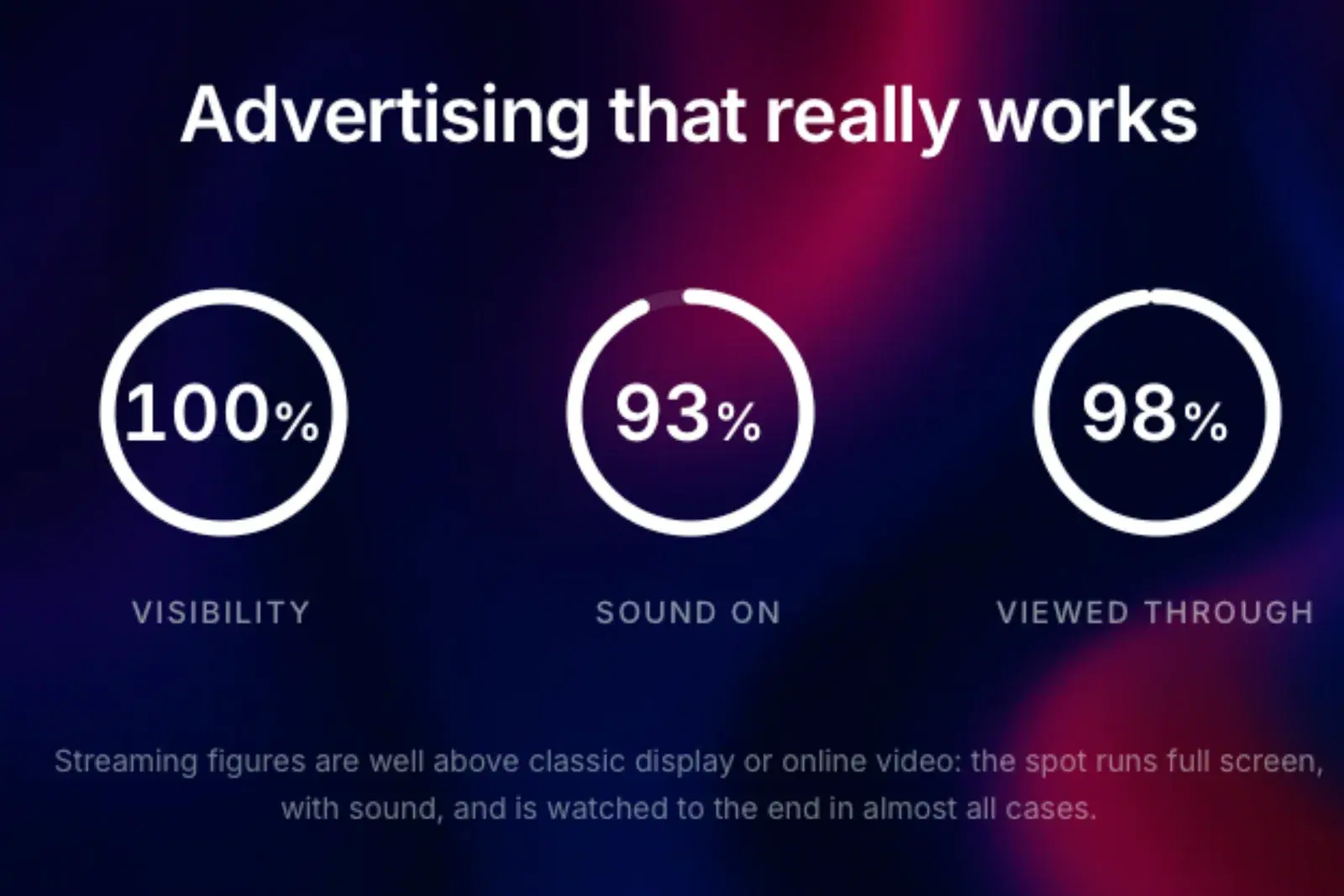
On television, this question does not arise. A streaming spot runs full screen, there is no half-visible edge, no scrolling past. That is why viewability of advertising on Connected TV is 100%. The contact you pay for actually appears on screen, in full.
Advertise in quality media!
Book a demoView-through: was the ad watched to the end?
The second metric, view-through or completion rate, measures how many viewers watch the spot all the way to the end. This is decisive, because the brand and call to action usually come at the close. Anyone who clicks away earlier misses exactly the message that matters.
In the feed, completion rates are naturally low, because the thumb is always ready to scroll on and most formats can be skipped. An analysis of Instagram video ads found that viewers who stayed for even two seconds scrolled on after around five seconds on average. The complete message thus reaches only a fraction of viewers.
On television, it is different. Streaming spots are typically non-skippable. On premium inventory, completion rates above 90% are common. At onescreen we regularly see view-through rates of around 98%. Your entire message gets through, not just the first few seconds.
Audibility: was the ad also heard?
The third metric is the one most often forgotten, even though it decides between being seen and being tuned out: audibility, meaning whether the ad played with sound. And here the social media feed has a fundamental problem.
Video in the feed runs silently most of the time. The industry association IAB puts it plainly: most videos in the social feed are watched without sound, the audience may be looking but is not listening. The measurement standard Moat even has its own metric for this (AVOC, audible and visible on completion), and its industry average sits at only around a quarter. Three out of four completed video impressions in the digital space are therefore either silent or not fully visible. Your music, your voiceover, your slogan: often simply inaudible in the feed.
On television, the sound is on almost all the time. Anyone watching a film or a match has the sound turned on. Your advertising is therefore not just seen but also heard, a whole sensory channel that the silent feed gives away, an effect closely tied to the lean-back effect, the relaxed, attentive state in front of the television.
What it adds up to
The three metrics reinforce each other. An ad that is viewable but not watched to the end fizzles out. One that plays to the end but stays silent loses half its impact. Only when all three come together, viewable, complete, audible, does a real contact happen.
This is exactly the point: in the feed you pay for impressions and hope that some of them work. On television you pay for advertising that arrives full screen, to the end and with sound. The single feed contact is cheaper to buy, no question. But if a large share of it is not viewable, not watched to the end or silent, you effectively pay for many contacts to get a few effective ones. The low price per impression says little about the price per actual effect, and that is often where the advantage flips. How this plays out for your budget is shown in the article How much does TV advertising cost?.
This is not an argument against social media, which has its place for fast, click-driven campaigns. It is an argument for factoring in media quality instead of only counting impressions. How this quality translates into real attention is shown in the article on the lean-back effect. And because more than one person is often watching the same television, the co-viewing effect adds to this media quality too.
IAB Europe describes this same difference: CTV offers a lean-back environment with high viewability, in contrast to the faster, often distracted scrolling in social feeds (IAB Europe's CTV 101 Guide, 2026).
Media quality at onescreen
With onescreen, you book advertising in exactly this high-quality environment: full screen on the television, non-skippable, with sound. In the dashboard you see on a daily basis how often your spot was shown and how often it was watched all the way through. Media quality thereby becomes a traceable number, not just a promise.
Part of the bigger picture: how media quality combines with other factors like viewing situation, environment and trust into the full premium effect of streaming advertising is shown in the article The Premium Quality of Streaming Advertising.
Want to see what that looks like for your brand? Book a free demo, we will show you a suitable campaign in 30 minutes. Or get started directly in the Ad Manager.
FAQ
What does media quality mean in advertising? It describes whether an ad even had the chance to work. Three metrics are central: viewability (was it shown visibly), view-through or completion rate (was it watched to the end) and audibility (was it heard with sound).
What is viewability? Viewability measures whether an ad actually appeared in the visible area of the screen. Under the Media Rating Council standard, a video already counts as viewable once half its area was on screen for two seconds. On Connected TV, viewability is 100%, often much lower in the social feed.
What is view-through or completion rate? The share of viewers who watch a spot all the way to the end. On high-quality streaming inventory it is often above 90%, at onescreen we regularly see around 98%, because the spots are non-skippable. In the feed it is usually low, because people scroll on or skip.
What is audibility? Audibility measures whether the ad played with sound. In the social feed, most videos run silently; on television, the sound is almost always on. This is decisive for impact, because music, voiceover and slogan otherwise go to waste.
Does that make streaming advertising better than social media? On media quality per contact, streaming is clearly ahead. Social media remains useful for fast, click-driven campaigns. The combination is often most effective: streaming for the high-quality brand contact, social for fast activation.