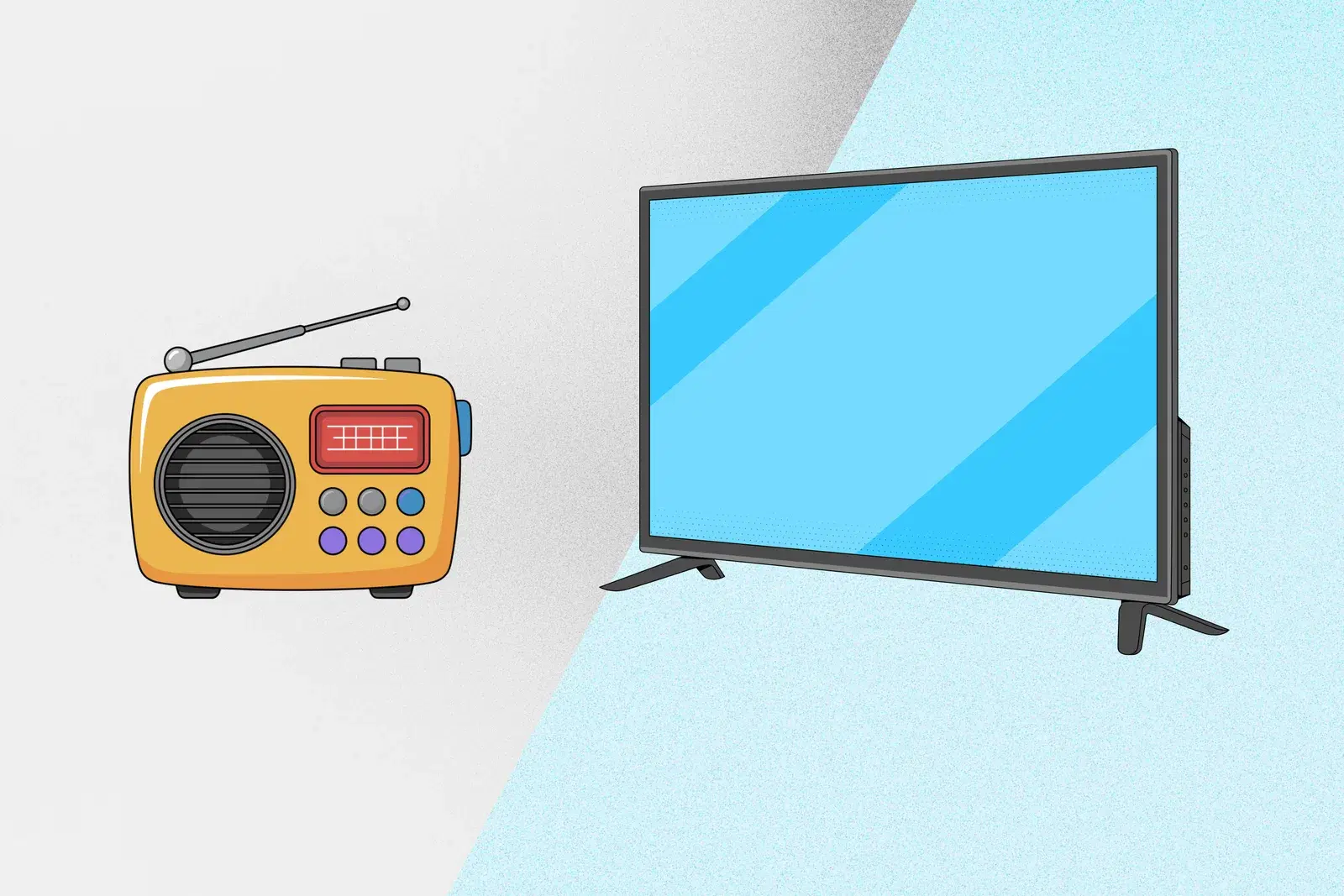
An earworm from the late seventies put it early and bluntly: when video overtook the radio star. What was a pop song back then is everyday reality in the advertising market today. Radio is not going away, no question, but attention has moved to the big screen.
For SMEs this means an uncomfortable truth about an otherwise likeable channel: radio advertising is cheap and has worked for decades, but it cannot show anything. The comparison below puts radio and streaming advertising on the television (Connected TV, or CTV for short) side by side, with everything radio can do, and everything it lacks.
The quick overview
| Criterion | Radio advertising | Streaming TV (CTV) |
|---|---|---|
| Senses | sound only | sight and sound |
| Attention | often a background medium (car, work) | lean-back on the big screen |
| Targeting | by station and airtime, fairly broad | precise by region, age, interests |
| Regional targeting | by broadcast area | down to postcode level |
| Measurement | difficult, mostly reach estimates | impressions, completion, reach, daily |
| Media entry point | low per-second prices, small CPM | onescreen campaigns from €1,000 |
| Production | audio spot from a few hundred euros | video spot with the help of AI, fast and cost-efficient |
Try streaming over radio!
Book a demoRadio cannot show anything
The most important difference is the one most often overlooked, because it sounds so obvious. Radio is an audio medium. However well your spot is written, your product stays invisible. The listener builds the picture themselves, or does not: the look, the packaging, the logo, the shop around the corner.
For a furniture store, a restaurant, a car dealer or an online shop, that is a problem. Wherever the eye buys, pure sound gives away half the message. Advertising effectiveness research has said the same thing for a long time, and everyday experience confirms it: what we see sticks better than what we only hear. Best of all is when both stick together.
This is exactly where streaming advertising plays its strength, whether AVOD, SVOD, FAST or BVOD, the main streaming models explained cover the differences. Sight and sound, full screen, on the biggest screen in the living room. The sound radio can do keeps running. The picture is added.
Heard in passing, not really seen
Radio runs while people do something else. In the car, while cooking, at the office. That is a strength and a weakness at the same time. A strength, because radio catches people when no screen is nearby. A weakness, because hardly anyone really listens. Anyone stuck in traffic staring at the light takes in the spot with half an ear at best.
On the television, the starting point is different. Anyone streaming, whether on Netflix, YouTube or one of the other leading streaming platforms in Germany, has sat down to watch something. The spot runs non-skippable and across the whole screen. A casual contact becomes an attentive one.
From scattergun to bullseye
You book radio by station and airtime and hope the right people happen to be tuned in. That scatters broadly but imprecisely, and part of the budget inevitably reaches people who will never need your offer.
With streaming, you define the audience yourself, by region down to the postcode, by age, by interests, across more than a hundred attributes. Regionally you are even more precise than the local station: instead of an entire broadcast area, you hit the exact catchment area of your shop. The budget lands where your customers live.
Guessing or knowing
Whether a radio campaign worked is hard to say. Reach estimates and listener surveys give an impression, nothing more. Whether your spot actually landed remains largely guesswork.
With streaming, it is in the dashboard, updated daily: how often your spot ran, how often it was watched all the way through, what reach resulted. Traceable while the campaign runs, instead of an estimate weeks later.
What speaks for radio
Radio has good arguments, otherwise the channel would not still exist. The cost per contact is low, the CPM sits below that of most other classic media. For campaigns that live on repetition, that pays off. On top of that, radio reaches people in moments without a screen, and in the car it is often the only available advertising channel. A catchy spot, played often enough, sticks.
For broad, cheap, regional repetition, radio thus remains a useful tool. Just one without a picture.
One more word on measurement on the streaming side, so expectations are right: unlike the click in online advertising, TV impact shows up more in reach and completion rates than in a direct click chain. Streaming works like brand advertising, it builds awareness and trust. Anyone who only looks at the immediate click underestimates the effect.
What it actually costs
Per contact, radio is often cheaper, there is no arguing that away. Per-second prices range from under a euro at small stations to three-figure amounts at the big ones.
But the price per contact says little about the price per impact. A cheap radio contact that fizzles out in rush-hour traffic and half misses people outside your audience can end up more expensive than a somewhat pricier streaming contact that arrives full screen, with visuals and full attention, exactly with the right people. What you pay extra for wastage in the radio scattergun, precise targeting saves you.
That leaves production, long the strongest argument for radio: an audio spot costs only a few hundred euros, a TV spot used to be a completely different matter. That is no longer true. onescreen creates spots with the help of AI, significantly faster and more cost-efficiently than the classic route. From existing material, images, logos, a few lines of text, a broadcast-ready spot is built. That removes the old "I don't even have a video", and radio's last real advantage along with it. How the streaming costs break down in detail is covered in the price guide How much does TV advertising cost?
Conclusion
The radio star is not obsolete, but it has been overtaken all the same. For the sense of hearing, radio remains a cheap channel, but attention and impact today lie with moving image on the big screen: visible, precisely targeted, measurable. And because a spot can now be produced quickly and affordably with AI, the old cost argument no longer holds either. If your advertising needs to be seen, not just heard, there is no getting around streaming TV.
We can best show you what this looks like for your business directly: book a free demo, and in 30 minutes a suitable campaign will be ready. Or get started directly in the Ad Manager.
FAQ
Does TV advertising work better than radio? For most messages, yes. Moving image is remembered better than sound alone, because it engages eye and ear at the same time. Radio remains strong for repetition and for moments without a screen, but it cannot show anything.
Is streaming advertising more expensive than radio? Per contact, radio is often cheaper. Once you factor in wastage and the higher attention, the picture shifts: streaming reaches the audience more precisely and arrives with visuals and full attention. What counts is the price per impact, not per contact.
Do I need an expensive video spot for streaming advertising? No. onescreen creates spots with the help of AI, faster and cheaper than the classic route. A broadcast-ready spot is built from existing material such as images, logos and text. The old "I don't have a video" no longer applies.
Can I target as regionally with streaming as with a local radio station? Even more precisely. Instead of being tied to a broadcast area, you target streaming down to postcode level and hit exactly your business's catchment area.
Should I replace radio with streaming entirely? Depends on your goal. If your advertising works visually and you want attention and measurability, streaming is the stronger choice. As a cheap repetition channel, for example for drivers, radio can still make sense as a complement.