
- The full-price check: anyone who subscribes to all relevant streaming services in Germany in their most expensive ad-free tier pays a cumulative total of up to 185.87 euros a month, a figure that illustrates the growing pressure on consumers and explains the trend towards ad-supported alternatives.
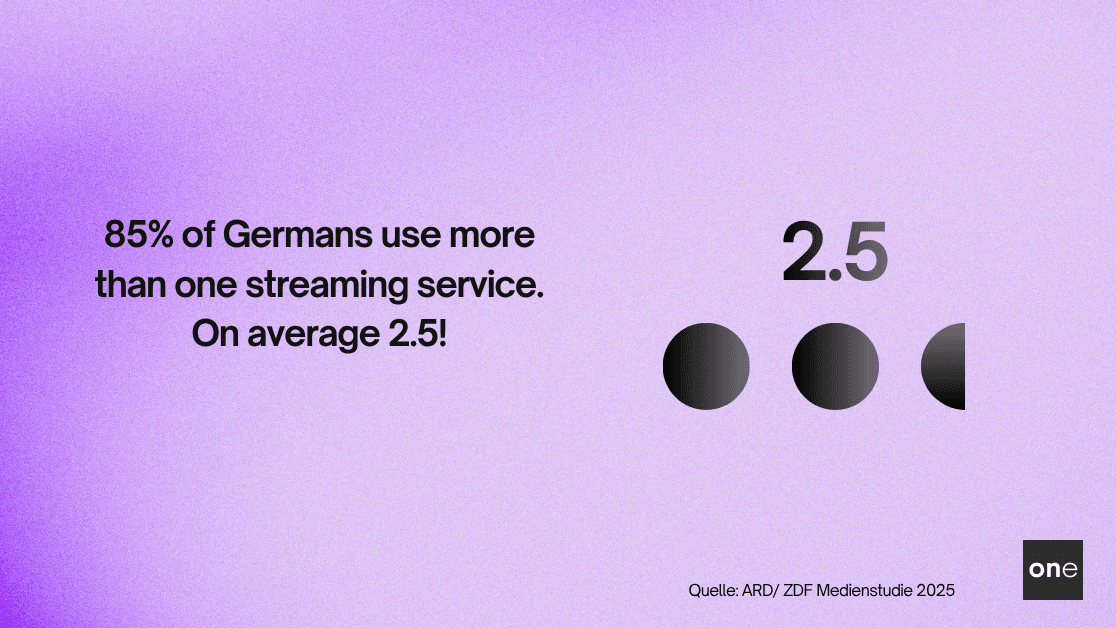
- The German streaming everyday: video-on-demand households use an average of 2.5 streaming services at the same time, with a monthly spending budget of around 30 euros. In return, the willingness to accept advertising rises (Simon-Kucher Global Streaming Study 2025).
- Ad subscriptions are booming: the share of German streaming users with an ad-financed subscription rose by 33% compared with Q4 2023 (GroupM Consumer Evolution Detector 2025).
- Netflix grows fastest in Germany: the Netflix ad subscription grew more strongly here, at +44%, than in any other European market, thereby opening a high-quality CTV advertising channel for brands (Digital i / meedia.de, 2025).
The full-price calculation: 185.87 euros a month
Anyone in Germany who wants to enjoy streaming to the full, series, films, sport, live TV, children's content, and do without advertising in the process, pays a lot, a great deal. If you add up the ad-free tiers of all services (Netflix Premium, Amazon Prime, Disney+, RTL+, WOW, DAZN, Apple TV+, Paramount+ and so on), you arrive at a total monthly bill of 185.87 euros.
Naturally no single household subscribes to all services at the same time, but the figure makes clear how confusing and costly the streaming ecosystem has become. It also explains why subscription fatigue in Germany is no longer a niche phenomenon.

How Germans really stream: 2.5 services, 30 euros
The reality is more pragmatic. According to SevenOne Media (Media Activity Guide 2025), video-on-demand households in Germany use an average of 2.5 streaming services in parallel. According to the Simon-Kucher Global Streaming Study 2025, the monthly budget for paid streaming subscriptions amounts to an average of 30 euros, an increase of 30% over the previous year, which reflects the platforms' increased price pressure.
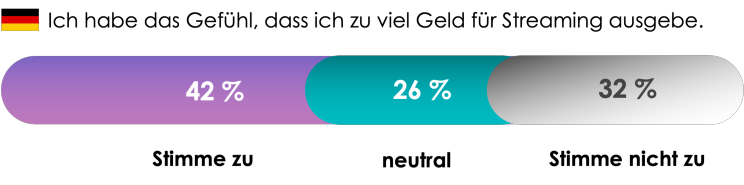
At the same time, the unease is growing: 42% of German streaming users say they feel they spend too much on streaming. Among those under 39, it is even 50%. And almost one in five cancelled at least one subscription in the past year. The consequence is foreseeable: users look for cheaper alternatives, and the platforms have introduced advertising models.
Subscription fatigue as the engine of change
The market responds to price pressure with a simple lever: the ad subscription. Netflix offers its cheapest package in Germany for 4.99 euros a month, compared with 19.99 euros for the ad-free Premium subscription, a difference of 75%. Amazon introduced advertising as standard in Prime Video in spring 2024. Disney+ followed the same pattern.
Despite lower subscription prices, the platforms often achieve higher total revenues per user, because advertising income is added. The deliberately high prices of the ad-free tiers thereby serve indirectly as a push factor into the ad-financed model, without users having the feeling of missing out on anything.
Germany: front runner in ad-tier growth in Europe
The shift to ad-financed streaming is particularly dynamic in Germany. According to GroupM (Consumer Evolution Detector 2025), the share of German streaming users with an ad-tier subscription rose by 33% compared with Q4 2023. In parallel, the use of ad-free Premium subscriptions fell by almost 13% year on year.
Especially striking: the Netflix ad subscription is growing faster in Germany than in all other European markets. Between November and April, the number of Netflix hours consumed in Germany on the ad subscription rose by 44%. In Spain it was 34%, in the United Kingdom 34%, in France 26% (Digital i, cited at meedia.de). The BB Media Analysis 2025 also confirms Germany as one of the fastest growing AVOD markets in Europe (+10.44%).
What this means for advertisers
The shift from the ad-free subscription to the ad tier is not an emergency solution for users, but a high-quality advertising environment for brands. Streaming on the Smart TV, the dominant device with 67% of SVoD usage time (Media Activity Guide 2025), combines large screens, a lean-back atmosphere, switched-on sound and precise targeting.
With growing reach in the ad tier, a professional advertising environment and scalable measurability, ad-financed streaming becomes the rising premium video channel in Germany in 2026, alongside classic linear TV.
Conclusion: the market sorts itself out
The era of the one ad-free streaming subscription is long gone. German households combine paid and ad-financed services by price and relevance. They add services and cancel them again. The platforms have long adapted to hybrid models, and they profit. For advertisers, a new, scalable channel with TV quality emerges: ad-financed streaming on Connected TV.