
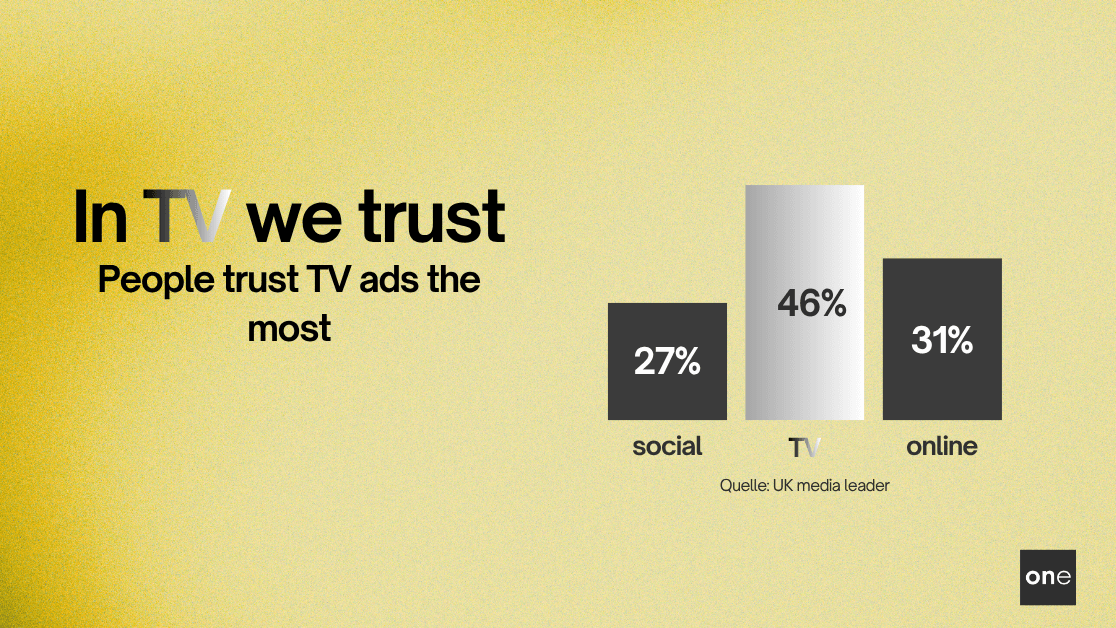
- 46% of consumers trust TV advertising, more than any other paid advertising format. Social media reaches 27%, online advertising 31% (Credos Trust Tracker 2025).
- TV advertising creates the strongest brand effect of all measured channels, and despite changed usage habits it remains the advertising environment most respected by consumers (Kantar Media Reactions 2025).
- 78% of consumers worldwide trust TV advertising. That makes television the most trusted paid advertising medium globally (Nielsen Global Trust in Advertising Study 2021).
Trust as currency in the media competition
At a time when advertising messages compete for attention across more and more channels, one question is becoming increasingly decisive for brands: where is their advertising not only seen, but also believed? The research answer is clear, and it points to the television.
The Credos Trust Tracker run by the British Advertising Association (AA) has documented the development of consumer trust in advertising for years. The 2025 data is remarkable: trust in TV advertising grew faster between 2021 and 2025 than for any other advertising channel, rising almost twice as fast as trust in social media advertising. With a 46% trust rate, TV leads the ranking of all measured channels, followed by cinema and radio (42% each), out of home (38%) and print media (37%). Social media (27%) and online advertising (31%) bring up the rear.
TV advertising: trust across all age groups
What is notable is that TV scores not only with older audiences. Among 35 to 54 year olds, TV is the most trusted channel with a 49% trust rate. But trust in TV advertising has also risen among 18 to 34 year olds, to 54%, compared with 51% the previous year (Credos Trust Tracker 2024). This means TV trust is growing even in the age group that uses streaming and social media most intensively.
The global picture confirms this finding: 78% of consumers worldwide say they trust TV advertising according to the Nielsen Global Trust in Advertising Study, the highest value of all paid advertising formats. For this, Nielsen surveyed more than 40,000 consumers in over 55 countries.
Why TV environments create trust
The high level of trust in TV advertising is no coincidence. It is a result of the environment. Television, whether linear or streamed via Connected TV, stands for editorially curated content, professional production and a regulated advertising environment. Brands that advertise on television benefit from a halo effect: the mere fact of being present on TV signals seriousness, scale and reliability to consumers.
According to Kantar Media Reactions 2025, TV advertising still delivers the strongest brand effect of all measured advertising channels. In 2025, 57% of global consumers said they viewed advertising positively in general, a record value. At the same time, Kantar shows that campaigns achieve a sevenfold higher impact among receptive audiences.
The contrast with the digital environment is sharp: social media struggles with brand safety concerns, algorithmically driven content, fake news, malicious content and a growing skepticism among users towards manipulative advertising.
Connected TV inherits the trust of television
Decisive for the industry: the trust capital of television transfers to Connected TV. Anyone who streams content on the Smart TV, whether via the ARD media library, Netflix or Amazon Prime Video, is in the same lean-back environment, on the same large screen, in the same relaxed viewing situation as with classic TV. The device is the same. The attention is the same. And trust in the advertising environment transfers as well.
For advertisers this means: Connected TV combines the precision of digital targeting with the trustworthiness of television, a combination effect that no other advertising medium offers.
Conclusion: trust is measurable, and it belongs to TV
The data is consistent, internationally documented and stable over several years: TV is the advertising medium with the highest consumer trust, and this trust is growing. In a media landscape where attention is scarce and skepticism is high, that is a strategic advantage brands should not ignore.